How Much Does It Cost to Recoat a Failed Epoxy Garage Floor?
So your garage floor coating didn't hold up. Maybe it's peeling in sheets near the door. Maybe the hot tires pulled it right off. Maybe it looked great for six months and then started flaking like sunburned skin. Whatever happened, you're now staring at a floor that looks worse than bare concrete — and you need to know what it's going to cost to fix it.
You're not alone. A significant number of garage floor coatings fail, especially DIY applications, and "how much to recoat" is one of the most common questions we get at Garage Floor Coating Finder. The short answer: it depends on what failed, how bad it is, and what you want to replace it with. The longer answer is below — and it's worth reading before you call anyone, because the decisions you make now will determine whether you're dealing with this problem again in two years or putting it behind you for good.
TL;DR — Recoating a Failed Epoxy Floor
- Stripping and recoating with epoxy: $800–$1,200 per stall (roughly $4–$8 per square foot)
- Stripping and upgrading to polyurea: $2,100–$2,900 per stall ($7–$12 per square foot)
- Just the removal/grinding step: $1–$3 per square foot before any new coating goes down
- Total cost if your $400 DIY kit failed: $2,400–$4,400+ when you add the wasted kit + professional redo
- Recoating over existing coating (if it's still bonded): 30–50% less than a full strip-and-recoat
Why Did Your Garage Floor Coating Fail in the First Place?
Before we talk money, it's worth understanding what went wrong — because the cause of failure directly affects what the fix costs. According to Galaxy Concrete Coatings, up to 80% of epoxy floor failures trace back to improper surface preparation. That's not a typo. Four out of five failures come down to what happened (or didn't happen) before the coating was applied.
The most common causes include:
Inadequate Surface Prep
This is the big one. If the concrete wasn't properly ground or profiled before the coating went down, the epoxy has nothing to grip. Acid etching — the method most DIY kits recommend — simply doesn't create the mechanical bond that diamond grinding does. According to FloorGuard Products, poor surface preparation is the single leading cause of coating delamination, and it's almost always the reason DIY floors fail within the first year.
Moisture Vapor Transmission
Concrete looks solid, but it's actually porous. Moisture from the ground underneath can push up through the slab as vapor, and when it hits the underside of a coating, it breaks the bond. Most homeowners don't test for this. Most professionals do. If moisture was the culprit, you'll need it addressed before any new coating goes down — otherwise you're just repeating the same mistake.
Hot Tire Pickup
You drive home, park the car, and the heat from your tires softens the epoxy just enough that when you pull out the next morning, the coating comes with it. This is incredibly common with water-based DIY kits and lower-grade epoxies. It's one of the main reasons professionals recommend polyurea or polyaspartic coatings for working garages. Our epoxy vs. polyaspartic comparison goes deeper on this issue.
Wrong Product for the Environment
A water-based epoxy kit from a big-box store is not the same product as a 100% solids commercial epoxy or a polyurea system. According to All Garage Floors, many failures come down to applying a consumer-grade product in an environment that demands a commercial-grade solution — high traffic, temperature swings, chemical exposure, and heavy vehicles.
How Much Does It Cost to Strip a Failed Coating?
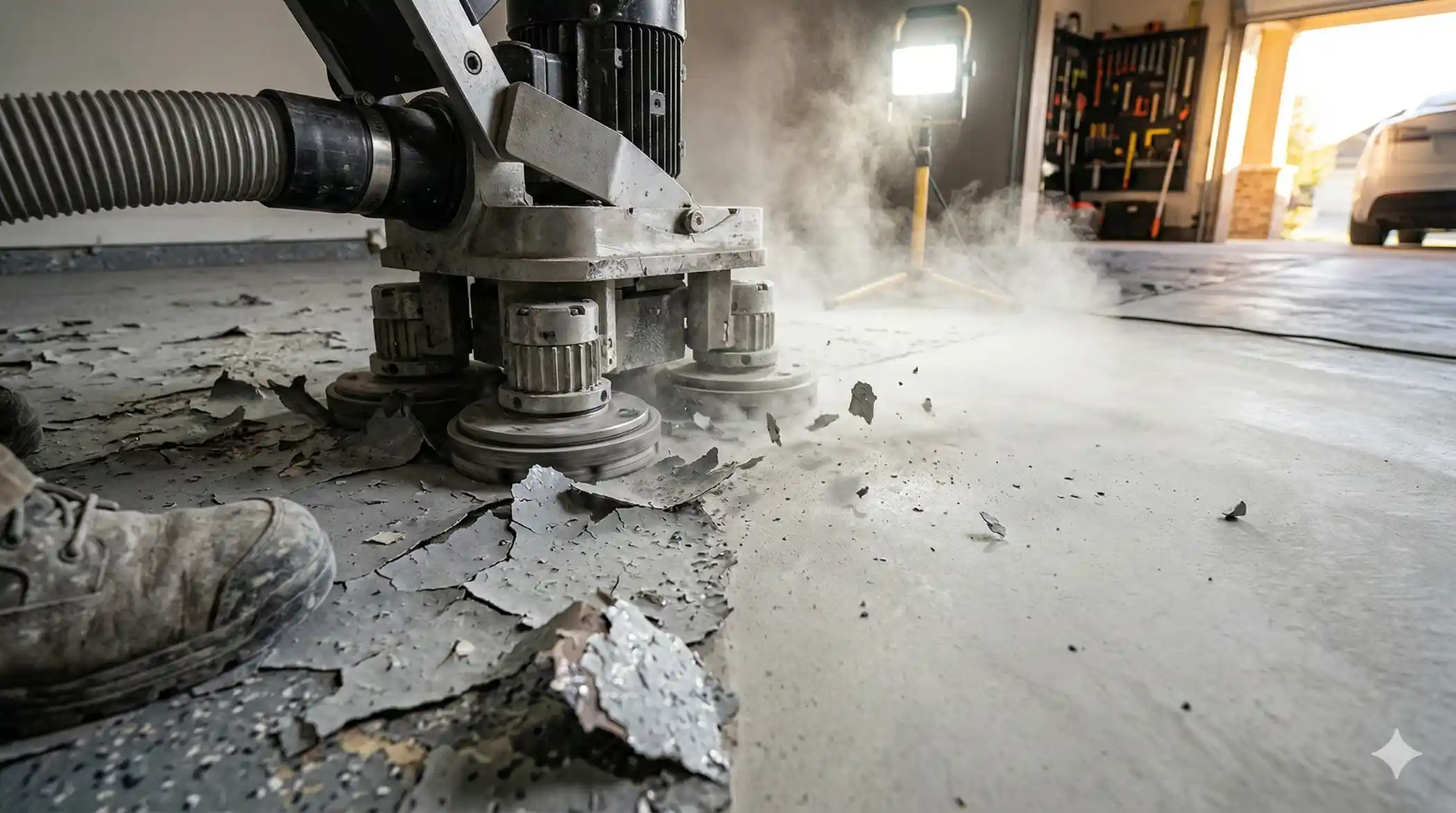
This is the part people don't budget for, and it's the reason recoating always costs more than a first-time installation. You can't just put new coating over failed coating. The old stuff has to come off first — and that means grinding.
According to All Garage Floors, if your coating is peeling or delaminating, a professional will need to diamond-grind the entire surface to remove the failed material and create a proper profile for the new coating. This removal step alone typically runs $1 to $3 per square foot, depending on how stubborn the old coating is and the condition of the concrete underneath.
For a standard two-car garage (400–500 square feet), that's $400 to $1,500 just for the grinding and removal — before you've spent a dime on new coating.
Can You Recoat Without Fully Stripping the Old Floor?
Sometimes, yes. According to Optus Resin, if your existing coating is still bonded to the concrete but just showing surface wear — fading, light scratches, worn-through areas — a recoat over the existing surface can cost 30% to 50% less than a full strip-and-recoat job. The contractor will scuff-sand the surface to create adhesion for the new layer, then apply fresh coating on top.
But here's the key distinction: this only works if the existing coating is still solidly bonded to the concrete. If it's peeling, bubbling, flaking, or lifting, you're looking at a full removal. There's no shortcut around delamination.
What Does a Full Strip-and-Recoat Cost for a Garage Floor?
Now let's put it all together. According to Angi, here's what you can expect to pay for a complete redo:
| Scenario | Cost per Stall | Two-Car Garage Total |
| Strip failed coating + new epoxy | $800–$1,200 | $1,600–$2,400 |
| Strip failed coating + polyurea upgrade | $2,100–$2,900 | $4,200–$5,800 |
| Surface recoat (no stripping needed) | $500–$800 | $1,000–$1,600 |
| DIY kit failure + professional redo | — | $2,400–$4,400+ total |
Note: These are typical ranges. Your actual cost depends on the size of your garage, the condition of the concrete, your geographic area, and whether you upgrade coating systems.
For a detailed look at current first-time installation pricing, see our 2026 garage floor coating cost guide.
Should You Replace With the Same Coating or Upgrade?
This is the question that matters most — and the answer depends on why the first coating failed.
If a basic epoxy failed because of poor prep work but you hire a professional who grinds the floor properly, another epoxy application could work fine. But if it failed because of hot tire pickup, moisture issues, or the inherent limitations of epoxy in your specific environment, putting down the same product is just setting up the same failure.
Here's the honest take: if you're already paying to strip a failed coating and start over, the incremental cost to upgrade from epoxy to polyurea is a lot smaller than the gap between a first-time epoxy install and a first-time polyurea install. You're already paying for the grinding. You're already paying for the labor. The difference is really just the coating material itself — and that upgrade buys you a product that's more flexible, more chemical resistant, and far less susceptible to hot tire pickup.
According to Level 10 Coatings, polyurea coatings are reported to last 15 to 20+ years compared to epoxy's 5 to 10 years — which means you're much less likely to be paying for another recoat down the road.
What About Recoating a Professional Installation That's Worn Out?
Not every recoat is a failure fix. Sometimes a professionally installed coating just reaches the end of its natural life. If your epoxy is 8–10 years old and showing wear but isn't delaminating, that's normal aging — not a failure.
In this case, a recoat is typically simpler and cheaper. The contractor scuffs the surface for adhesion and applies fresh material on top. According to Optus Resin, this kind of maintenance recoat can be 30–50% less than a from-scratch installation, since the prep work is dramatically reduced.
This is also a natural opportunity to upgrade. If you had epoxy installed a decade ago and it's time for a refresh, upgrading to polyurea at the recoat stage is a smart move — you get another 15–20 years of performance and you avoid paying for full removal.
How to Avoid Paying for a Recoat in the First Place
The cheapest recoat is the one you never need. Here's what separates a coating that lasts from one that fails:
- Diamond grinding, not acid etching: This is the single biggest predictor of long-term success. If your contractor doesn't grind, find one who does.
- Moisture testing before coating: A simple test that takes minutes and prevents the most frustrating type of failure.
- Professional-grade products: 100% solids epoxy or polyurea/polyaspartic systems — not consumer-grade water-based kits.
- Multi-layer systems: Primer, base coat, broadcast layer, and topcoat. Each layer serves a purpose.
- Written warranty on labor and materials: If a contractor won't warranty their work, that tells you something.
For more on what proper preparation looks like, our guide to preparing your garage floor breaks down each step.
How to Find a Contractor Who Can Fix a Failed Garage Floor
Recoating a failed floor is a different job than a first-time installation. You need someone who can diagnose why the first coating failed, remove it properly, address any underlying issues (moisture, cracks, contamination), and apply a system that won't repeat the problem.
When you're getting quotes, ask these questions:
- Have you recoated failed floors before? Can I see examples?
- Will you test for moisture before quoting?
- What removal method do you use — grinding or chemical stripping?
- What coating system are you recommending, and why is it different from what failed?
- What warranty do you offer on the recoat?
We recommend getting 2–3 quotes so you can compare approaches, not just prices. Find vetted garage floor coating contractors near you through our directory. Whether you're in Michigan, Colorado, Arizona, or anywhere else, we can connect you with professionals who know how to handle recoating jobs.
Bottom Line
A failed garage floor coating is frustrating, but it's fixable. If the existing coating is still bonded and just worn, a surface recoat can run 30–50% less than starting from scratch. If it's peeling and needs full removal, you're looking at $1,600 to $5,800 for a two-car garage depending on the replacement system you choose. The most expensive option? Doing the same thing that failed the first time and paying for a third attempt. Invest in proper preparation and the right coating system now, and this should be the last time you deal with this problem.
Looking for a Garage Floor Coating Pro?
Browse our directory of verified contractors in your area.
Find Contractors