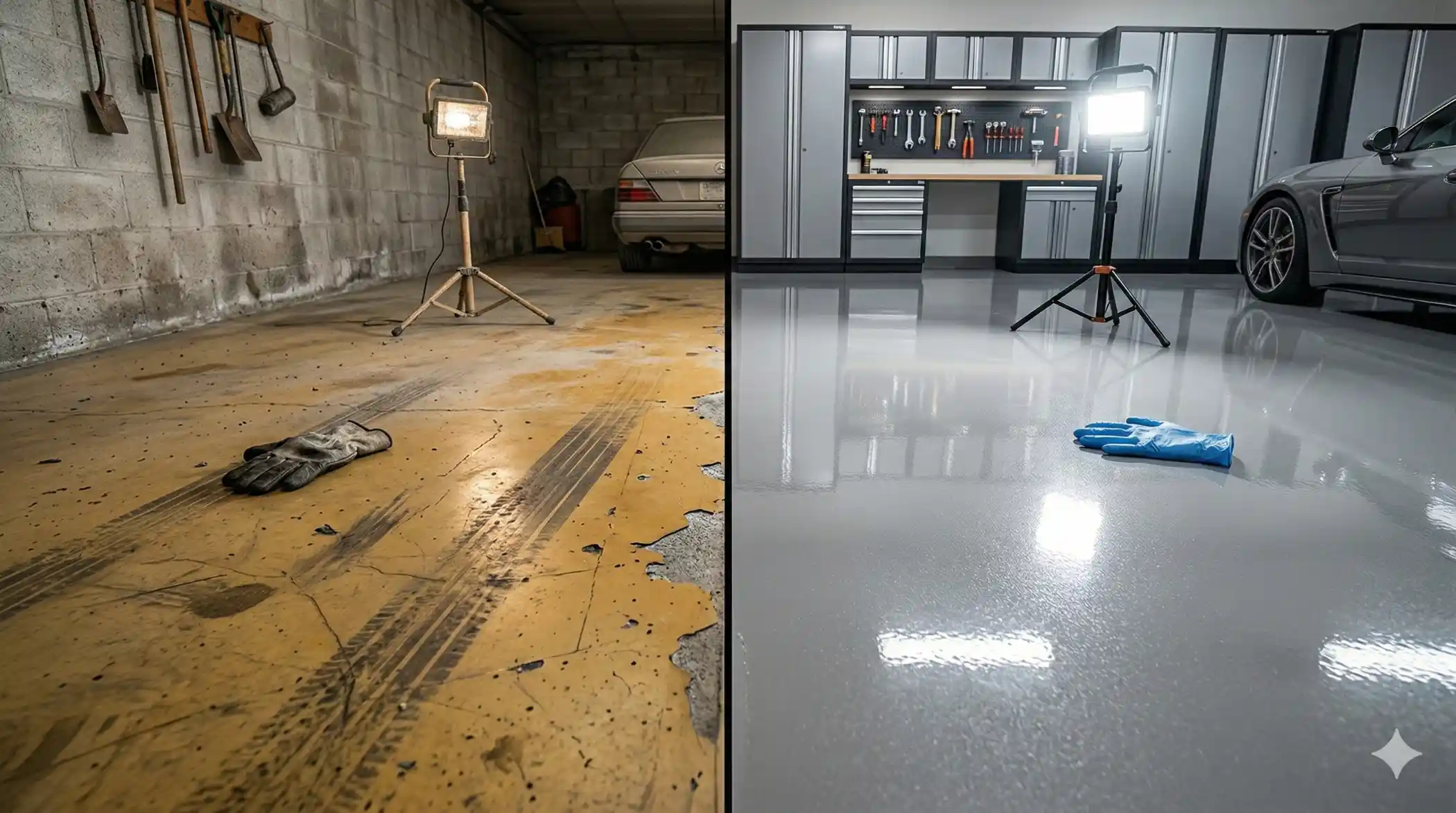
Penntek Polyurea vs. DIY Big-Box Store Epoxy: A Real Cost Comparison Over 10 Years
On paper, this isn't even close. A Rust-Oleum EpoxyShield kit costs around $200 to $400. A professionally installed Penntek polyurea system runs $3,000 to $7,000. Why would any rational person spend ten to twenty times more for a garage floor coating?
Because they've done the math over more than one weekend. When you zoom out from the sticker price and look at what each option actually costs over a 10-year period — including reapplications, failures, time, and the intangibles that never show up on the receipt — the picture flips. We built Garage Floor Coating Finder to help homeowners connect with professional coating contractors who use systems like Penntek, and a big part of why is this exact cost reality. Let's run the numbers.
TL;DR — 10-Year Cost: Professional Polyurea vs. DIY Epoxy
- DIY epoxy kit (Year 1): $350–$900 all-in for a 2-car garage
- DIY epoxy over 10 years: $1,400–$3,600+ (2–4 reapplications expected)
- Professional polyurea (Year 1): $3,500–$6,000 for a 2-car garage
- Professional polyurea over 10 years: $3,500–$6,000 (zero reapplications expected)
- DIY kit that fails + professional redo: $2,400–$4,400+ in total
- Bottom line: DIY epoxy costs 40–60% of a professional polyurea in Year 1, but can cost the same or more by Year 10
What Does a DIY Big-Box Epoxy Kit Actually Cost?
Let's be fair to the DIY option and count everything — not just the kit price on the shelf.
According to All Garage Floors, a standard Rust-Oleum or RockSolid kit runs around $200 to $400 for a two-car garage. But that's just the coating. Once you add in everything you actually need, the number grows:
- Epoxy kit: $200–$400
- Concrete grinder rental or acid etch kit: $50–$200
- Crack filler, patching compound: $20–$50
- Rollers, brushes, mixing buckets, application tools: $30–$60
- Tape, plastic sheeting, degreaser: $30–$50
- Decorative flakes (if not included): $20–$40
Realistic all-in materials cost: $350–$900 for a single application.
And then there's your time. Most DIY kits require 2–4 full days of work — a weekend for prep and application, then waiting for cure time before you can use the space. That's time you could spend on literally anything else.
What Does a Professional Penntek Polyurea System Cost?
Professional polyurea coatings from systems like Penntek typically run $7 to $12 per square foot installed, according to Croc Coatings. For a 400–500 square foot two-car garage, that puts you in the $3,500 to $6,000 range.
According to Atlas One Day Floors, a typical 500-square-foot garage at around $10 per square foot comes to approximately $5,000 installed. That includes diamond grinding, moisture testing, crack repair, primer, base coat, decorative flake broadcast, and a UV-stable polyaspartic topcoat — the full multi-layer system.
What's included in that price that isn't included in the DIY kit:
- Professional diamond grinding (not acid etching)
- Moisture vapor testing
- Crack repair and concrete patching
- Commercial-grade multi-layer coating system (15–20+ mils thick vs. DIY's 3–5 mils)
- Warranty on both materials and labor
- Zero weekends of your own labor
For a full pricing breakdown, check our 2026 garage floor coating cost guide.
How Long Does Each Option Last?
This is where the 10-year math starts to shift — dramatically.
DIY Epoxy Lifespan
According to FloorTech Concrete Coatings, water-based DIY epoxy kits typically last 2 to 3 years under normal garage use. Some hold up longer in light-duty environments, but in a working garage with hot tires, road salt, and regular traffic, 2–3 years is a realistic expectation. Even under ideal conditions, most consumer-grade epoxy maxes out at 5 years before showing significant wear.
That means over a 10-year period, you're looking at 2 to 4 applications of a DIY kit to maintain a coated floor. Each application means buying new materials, spending another weekend on prep and application, and hoping it sticks better this time.
Professional Polyurea Lifespan
According to Level 10 Coatings, polyurea and polyaspartic coatings are reported to last 15 to 20+ years with proper installation. That means a single application in 2026 is still going strong in 2036 — and well beyond. Over a 10-year window, you apply once. That's it.
The 10-Year Cost Comparison: Running the Actual Numbers
Let's model three realistic scenarios for a standard two-car garage (450 square feet):
| Scenario | Year 1 Cost | 10-Year Cost | Weekend Days Spent |
| DIY epoxy — best case (lasts 5 years, recoat once) | $500 | $1,000 | 6–8 days |
| DIY epoxy — realistic (lasts 2–3 years, recoat 3x) | $500 | $2,000–$3,600 | 12–16 days |
| DIY epoxy fails — hire pro (kit fails, professional redo) | $500 + $3,500–$5,000 | $4,000–$5,500 | 3–4 days |
| Professional polyurea (single application, lasts 15–20+ years) | $3,500–$6,000 | $3,500–$6,000 | 0 days |
Note: DIY reapplication costs assume $500 per application (materials + supplies). Professional polyurea assumes a single installation with no maintenance recoat needed within the 10-year window.
In the best-case DIY scenario, you save real money — but you also spend 6–8 weekend days doing the work yourself. In the realistic scenario, the savings shrink to almost nothing. And in the failure scenario — which happens more often than people expect — you end up paying more than if you'd just hired a professional from the start.
What About the Costs That Don't Show Up on a Receipt?
The spreadsheet comparison above doesn't capture everything. There are real costs to the DIY route that are hard to quantify but absolutely real:
Your Time
Every reapplication means emptying your garage, prepping the floor, applying the coating, and waiting for it to cure. That's 2–4 days each time where your garage is unusable and your weekend is gone. Over 10 years with 3–4 applications, that's 8–16 days of your life spent on garage floors.
Living With a Deteriorating Floor
DIY epoxy doesn't fail all at once. It fails gradually — a peel here, a chip there, yellowing from UV exposure, hot tire marks that won't come out. You live with a floor that looks progressively worse for months before you get around to recoating it. A professional polyurea coating still looks essentially new after 5, 8, even 10 years.
The Frustration Factor
There's a real psychological cost to watching a weekend project you worked hard on fall apart. If you've browsed any DIY forum, you've seen the posts: "My epoxy is peeling after 4 months, what did I do wrong?" That's not just a financial loss — it's a frustrating experience that most people would rather avoid.
Resale Perception
A professionally coated garage floor with a transferable warranty tells potential buyers that the homeowner invested in the property. A DIY coating that's peeling in the corners tells them the opposite. It's not a line item on an appraisal, but real estate agents consistently say that a clean, well-finished garage makes a positive impression during showings.
What Makes Professional Polyurea Systems Different From DIY Kits?
It's not just the price tag that's different — the products themselves are fundamentally different materials applied in fundamentally different ways.
| Factor | DIY Big-Box Epoxy | Professional Polyurea (Penntek) |
| Product type | Water-based or solvent-based epoxy | 100% solids polyurea/polyaspartic |
| Coating thickness | 3–5 mils | 15–20+ mils (multi-layer) |
| Surface prep | Acid etching | Diamond grinding |
| Hot tire resistance | Poor — common failure point | Excellent |
| UV stability | Yellows over time | UV-stable, no yellowing |
| Chemical resistance | Moderate | High |
| Cure time | 2–3 days before foot traffic | 24 hours to full use |
| Warranty | Product warranty only (no labor) | 5-year to lifetime on labor and materials |
For more on the technical differences between coating types, our epoxy vs. polyaspartic guide covers the performance gap in detail.
When Does DIY Epoxy Actually Make Sense?
We're not here to tell you that DIY is always wrong. There are scenarios where a big-box epoxy kit is a reasonable choice:
- Small utility areas that won't see car traffic or hot tires
- Rental properties where you need a quick cosmetic improvement, not a 20-year solution
- You already own a concrete grinder and have experience with surface preparation
- The space is temporary — you're selling the house in a year or converting the garage to another use
But for your primary garage — the one you park in daily and want to look great for the foreseeable future — the 10-year math consistently favors the professional route.
Can You Finance a Professional Coating to Reduce the Upfront Gap?
One of the biggest barriers to choosing the professional option is the upfront cost difference. Dropping $5,000 at once is a lot more painful than spending $400 on a kit. But many professional coating contractors now offer financing that makes the monthly cost surprisingly manageable.
With a 0% APR promotion over 24 months, a $5,000 polyurea coating works out to about $208 per month. Over 48 months at a typical rate, it can be as low as $106 to $122 per month. That's the cost of a streaming subscription or two — for a floor that lasts two decades.
For more on financing options, see our guide on how homeowners pay for garage floor coatings.
How to Get Started With a Professional Coating
If the 10-year math has you leaning toward the professional route, the next step is getting real quotes — not internet estimates — from contractors who use commercial-grade polyurea systems. We recommend getting 2–3 quotes so you can compare coating systems, warranties, prep methods, and pricing.
Find professional garage floor coating contractors in your area through our national directory. Whether you're in Illinois, Virginia, Oregon, or anywhere else, we can connect you with vetted professionals who install Penntek, Versatile, and other commercial-grade polyurea systems.
Bottom Line
A DIY big-box epoxy kit costs less on Day 1. That much is true and always will be. But over a 10-year window — factoring in reapplications, the realistic lifespan of consumer-grade products, and the very real possibility of failure — a professional polyurea coating frequently ends up costing the same or less while delivering a dramatically better result. The $400 kit isn't cheap if you apply it four times. And the $5,000 professional job isn't expensive if you never have to think about your garage floor again.
Looking for a Garage Floor Coating Pro?
Browse our directory of verified contractors in your area.
Find Contractors